
Trending
This story is from January 12, 2020
Open Book Library springs up for the love of reading
A stroll near Balgandharva Rangmandir on JM Road will reveal an iron bookshelf housing about 50 books in all languages. The bookshelf is the third installed under the Open Library Movement, a movement that propagates the Right to Read and works on a unique system of book donations and transactions.
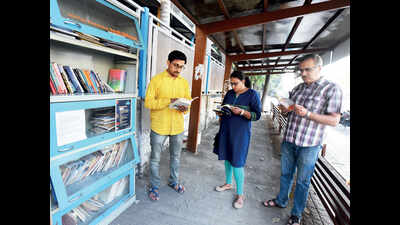
The idea behind the Open Library Movement is to bring these books to readers who want to read. The books were contributions from people who wanted to donate to the movement
Prithviraj More (21), a student of Indira College returns a book diligently to its shelf on JM Road.

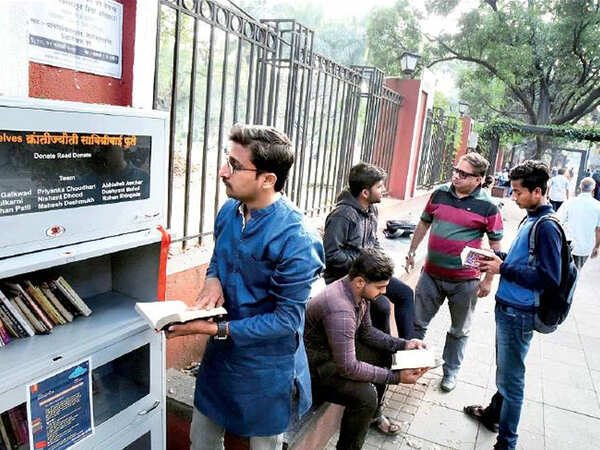
It all started with a cupboard near Jeet Ground at Kothrud on December 7. Named after Chhatrapati Shivaji Maharaj, the cupboard housed about 100 books. Started by a group of ten youngsters, the Open Library Movement entails setting up a bookcase with donated books. Books are free access and anyone can donate their books and borrow as well.
The second cupboard or ‘box’ of books was installed near Paranjpe School on Karve Road on December 16 and was named after Swami Vivekananda. The most recent one was the one on JM Road and was installed on Savitribai Phule’s birth anniversary on January 3, and so, named after her.
Writer Abhishek Awchar, who is part of the group, says the basic concept behind the movement was to bring more books to the readers. “When a man buys a book and reads it, he is reluctant to part with it. He then installs a bookcase and keeps the book at home. In this way, during his lifetime, the man collects hundreds of books which he reads a couple of times throughout his life.”
The idea behind the Open Library Movement is to bring these books to readers who want actually want to read, Awchar said.
He explains that instead of selling the books to scrap dealers, these books if donated to the Open Library Movement help propagate the love of reading.
“The start of the movement was with 100 books. The box itself cost around Rs 7,000, so we all pitched in.The books were contributions from people who wanted to donate to the movement. The first day we thought we’d put up a small box and it may work out for long, but so far it has been a resounding success. People pick up the books, read and often put back around five books in return,” Awchar said.
About the worry of stolen books, Awchar says, “We felt that the day books start getting stolen, it’s a good thing because they are getting read. In this way, it gets forwarded to more people. The basic concept is don’t dump these books,” he said.
Awchar said the group had a lot of enquiries asking for more book boxes to be set up. “We feel making it as open access is better. No money transaction is our basic theme. People have tried donating money. Instead, we ask them to donate their books,” he said.
Every day around 50 books are taken out, Awchar says. “The response has been really good. Transaction is 50 books per day and donation is about 60 per box.”
Priyanka Choudhari, one of the leaders of the movement, said they hoped to take the movement to across Maharashtra. “We want to take it all across Maharashtra, particularly to rural areas. We want to start something called the children’s box with kids’ books and something called the educational box.”
She added that children in rural areas cannot easily access books. “We want them to have access to these books. From every good book we read, we are exposed to thoughts and emotions. So these books will play a big role in the children’s future,” she said.
About educational boxes, she said this would be an initiative where they would involve schools and colleges. “When students graduate to the next class, they don’t need their old books any more. They can deposit these books in the educational boxes for those who can’t afford these books. It will really be helpful for the next class,” she said.
End of Article
FOLLOW US ON SOCIAL MEDIA





Hot Picks
TOP TRENDING
Trending Stories
In City
Entire Website
- Breathtaking cosmic catwalk! SpaceX makes history with first-ever private spacewalk
- 2 Army officers thrashed, their female friend gang-raped in Madhya Pradesh
- Bangladesh announce Test squad for India tour
- Top fastest trains in the world: From China's CR Harmony to Germany's ICE
- Amid Shannon Sharpe Viral Video, Former ESPN Host Michelle Beadle Reacts Claiming It Was Not Her
- Ayushman Bharat insurance scheme expanded to cover elderly above 70
- 'Will be demolished if... ': Himachal minister's assurance amid Shimla mosque row
- Mumbai's Haji Ali and Mahim dargahs cancel Eid shamiana
- Garena Free Fire MAX redeem codes for September 11, 2024: Win free room cards, skins, diamonds, pet skins, and more rewards today
- GK for students: Top 8 Largest Mammals in the World
- In the (y)ear of conspiracy theories, Trump hears insults galore
- On Mamata's 'ready to resign' offer, protesting docs say 'want justice'
- Why you should not be fooled by ‘20-year SIP crorepati’ dream
- Swiss authorities freeze more than $310mn linked to Adani Group: Hindenburg
- IAF wants Tejas jet production to be ramped up as US delays engines supply
- Haryana polls: Rebellion erupts after Congress leaders file independent nominations
- Your cousin’s poo can now cure your chronic stomach problems
- Planning to buy iPhone 16? How much Apple will give for iPhone 12 & others
- Pandya triggers speculation over his Test comeback
- 'Given many reasons ... ': Former FBI official says Trump could be Russian 'asset'

Popular Categories
Hot on the Web
Top Trends
Trending Topics
Alia BhattMalaika Arora Father DeathArbaaz KhanNatasa StankovicMr Bachchan OTT ReleaseNational Parks In IndiaSelena GomezGOAT CollectionVikas Sethi DeathMalayalam ProducersIndia's Best Dancer 4Simi GarewalDilli BabuIndian National ParksLaung BenefitsVikas SethiiPhone 16Microsoft 365 OutageCsir Ugc Net 2024Wordle Answer
Living and entertainment
Latest News
Epilepsy medication shows promise of treating sleep apnoea symptoms: StudyIndia successfully flight tests surface-to-air missileDigest this: Unhealthy gut may be linked to Parkinson’s diseaseCSIR UGC NET 2024 result declared: Steps to download scorecards at csirnet.nta.ac.in'Played a big role in turning the cricket around': Ricky Ponting applauds Virat Kohli’s brilliance as India’s former captainAadhaar card update: Do you have to compulsorily update details on your Aadhaar every 10 years?Single Indians are now choosing slow, meaningful dates over-elaborate outings, reveals an online dating platform’s surveyExclusive- Saurabh Gumber reveals joining a new show during Ganeshotsav says, "I consider it as Bappa's small gift and believe he has great plans for me ahead"Who was Illia 'Golem' Yefimchyk, the Belarusian bodybuilder who consumed 2.5 kg of meat and 108 sushi pieces daily before his death at 36?Pakistan: Bilawal cautions Shehbaz govt against political victimisation, points to Imran Khan's caseVijay Varma reveals he was DROPPED from 'Sacred Games' at the last minuteMahindra Thar Roxx with VIN 0001 to be auctiond for charity: How to registerWWE Star Discusses Why Sid Vicious Deserves a Hall of Fame SpotVijay Sathya-starrer 'Dhil Raja' to release in SeptemberHarvard University Sees Drop in Black Freshman Enrollment Post-Supreme Court Ruling on Affirmative ActionSalman Khan surrounded by bodyguards as he arrives at Malaika Arora's mother's house to offer his condolences - WATCHCMF Buds Pro 2 by Nothing review: Big delivery on a budgetMallika Sherawat makes big screen comeback in Rajkummar Rao's 'Vicky Vidya Ka Woh Wala Video'; director reveals why he cast her
Copyright © 2024 Bennett, Coleman & Co. Ltd. All rights reserved. For reprint rights: Times Syndication Service